Robert Mugabe Yard Sale

I am, as I do so often, browsing through Ebay Germany looking for furniture and general inspiration. And I have found it indeed, although not quite as expected.

Have you ever seen anything QUITE that hideous?

Will somebody please tell me ONE redeeming quality or ONE reasonable purpose of these... things? Hell, they don't even have snob value. Who on earth is buying that for miserly EUR 450,00 a chair? Who has pre-owned it? Robert Mugabe?

What makes a Gentleman?

I cross-posted my entry about Michelle Obama's outfits at IBA, which triggered off an interesting discussion that merits further elaboration here.

It is apparent, that Barack Obama has good taste (and either the daughters come after their father or he is the one who chooses their dresses, not sartorially-callenged Michelle). His outfit is impeccable and I went so far in the IBA comment section as to say that he appears to be, from his attitude, bearing, looks and poise, more of a gentleman than any other American president I remember in my lifetime. I later had to admit that I forgot Bush Father, who is in the same class.
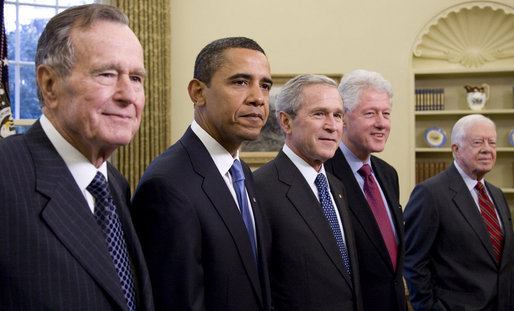
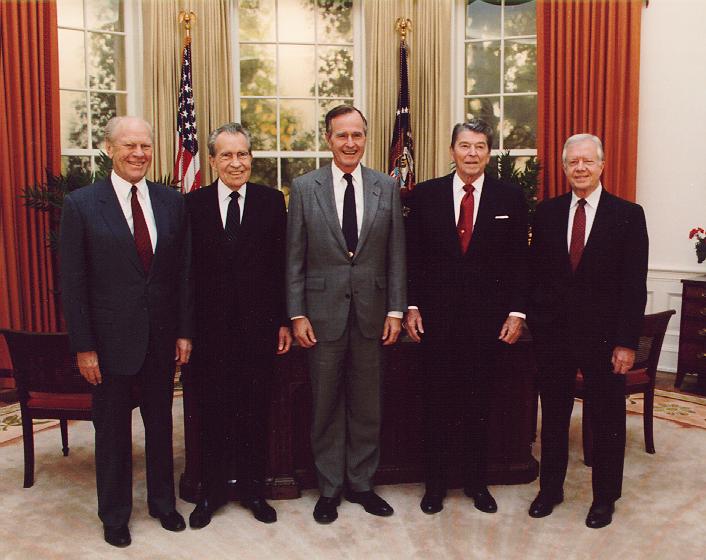

Of course, and now the usual disclaimer is in order, my following assessment has nothing to do with the former presidents' politics, not even whether I like them or not. It isn't either, an assessment of those men's individual character, apart from the cases where it clearly influences the physiognomy. Some of those whom I do not consider gentlemen by looks may clearly be or have been, by their personalities. I hopes this clarification helps.

So here we go: The first American president during my lifetime, but whom I do not remember having ever seen on television (we got TV in 1956, if I remember correctly and I was hardly ever allowed to watch it), is Dwight D. Eisenhower. A gentleman? Not quite. To me he looks like the poster boy of a German non-commissioned officer of the old school.

John F. Kennedy? Too much teeth, too much of an upstart, but he was certainly not without "class".

Lyndon B. Johnson? Awmegawd! He is best described by three words: common, common and common.

Richard Nixon? Had "crook" and "horrible little man" written all over him.

Gerald Ford? Not quite. Maybe he is just "too American" for me to appreciate his appearance fairly. He resembles Eisenhower more than just a little bit, who, too, just falls short of being a gentleman in my book.

Jimmy Carter? The very epitome of a horrible little man.

Ronald Reagan? To me, he comes across as a nice man of working class origin. Not as an upstart like Kennedy, but like somebody who has worked (physically too) long and hard to acquire status and conducts himself dignifiedly, but no, not like a gentleman.

George H. W. Bush? He fits the bill. Nice, polished, well dressed and not too "aggressively American" for this European's liking.

Bill Clinton? Add a "dirty old" to the "horrible little man". Again, it's written all over his smug face.

George W. Bush? You must be joking! Not even the artist who painted his official portrait managed to quite wipe that moronic look off his face. I even don't totally dislike the man, but I haven't, not even once in eight years, seen a picture where he does NOT look like an idiot. Here is a roster of all American presidents together with their portraits.

Barack Obama? Yes, definitely. He is extraordinarily favoured by nature with his tall and slim physique and a pleasant mixture of his white and black genes, and, no doubt, he knows how to make the best of it.

After much soul-seeking, it seems that my European background influences my judgement considerably. There are certain social markers one can not understand if one hasn't been brought up within a culture. So, for explanatory purposes, there follow some European dignitaries, and I wonder whether Americans will agree:


Prince Charles? Yes, in an upper-class-twit-of-the-year-contest-winner sort of way. Prince Andrew? He has written "bully" all over his face and Prince Edward is painfully insignificant. So no and maybe.

Their father? Yes!

King Juan Carlos of Spain: Perfect, in and out of uniform:

To prove that is is not JUST a princely parentage that maketh a gentleman, here a picture of the Habsburg family, celebrating Archduke Otto's 95th birthday:


Otto would be Emperor of the Holy Roman Empire of the German Nation or at least Emperor of Austria if the Holy Roman Empire of the German Nation still existed or if Austria hadn't abolished the monarchy in 1919 and he and his family look like a bunch of trolls.


And to prove, reversely, that even a man from the humblest of origins can manage to look like a gentleman I introduce former chancellor Gerhard Schröder here.

And to finish on a nice, ghost-trainy notion, here we have Vladimir Putin and Nicholas Sarkozy:

If the term "horrible little man" wouldn't already exist, it ought to be invented for "Sarko". (Gosh, aren't those yobs BORN with a mobile phone glued to one of their ears?) Putin? Markedly better, weren't it for his choice of suits one size too small and the vulpine KGB-look on his face.

To summarize, a "good family" and education helps, as does dress-sense, a tall and slim physique and - even more - a clean-cut face and apparent intelligence. There are, however, clowns from old and "good" families, intelligent, good-looking men who do not, or not quite, make it, as there are well-dressed yobs. At the end of the day, I don't have an answer to my own question.

Oh yes, I'd like to add one thing: NEVER EVER have an obscene amount of hair if you want to look like a gentleman, specifically if you are past your first youth. Bill Clinton and John Kerry are excellent examples. My mother calls it "child molester hairdo", and although I am not quite sure what she means (neither does she), it seems to fit in an eerie, unexplainable sort of way.

The Corporate State - Blessing or Curse?

At her highly intriguing blog A Letter To The Times, Cassandra Goldman published yesterday the thought-provoking entry Aristocracy fosters high achievement. Bringing back the monarchy seems indeed too weird a concept to merit serious contemplation. But is it really?
The sacred cow, or perhaps I should say golden calf, of “equality” is wreaking immeasurable damage on our society. It started with a principle that at least sounds good, that of “equality before the law”. Of course, equality before the law precludes any sort of nobility or aristocracy, and now we are feeling the lack of those.

The principle of equality before the law had its first major exploitation when feminists demanded that women be treated precisely the same as men by the law. The problem here is that women are not the same as men. Women have different capabilities and needs. Women require more protection from roving criminals; men are more apt to be able to defend themselves... Naturally, the attempt to force the law to treat men and women equally has backfired in a thousand ways, and by now, of course, the legal inequality has simply been adjusted...

The mania for “equality” has created in most people a pathological intolerance for being shut out of anything. It has also led to an excessive emphasis on age, as children or adolescents are among the few people who can still be justifiably discriminated against. In the introduction to a recent edition of one of E. Nesbit’s novels, a modern woman told us everything that was wrong with these nonetheless charming novels. (I don’t have a sarcasm font, but let me assure you that the sarcasm is very much there.) She attacked a scene in which a man took one of the boys aside for a man-to-man talk about how he shouldn’t be mean to his sisters because girls and boys are different, and have to be to do the grownup work of women and men. She was furious at how “patronizing” this was; personally, I wish that the boys I was forced to associate with as a child had patronized me that way. She was also outraged that these upper-class children gave orders to the family’s adult servants, and demonstrated better judgment than they did. She did not explain how she thought the children and servants ought to have related to each other, but I hazard a guess that she thought that these children, who would grow up to have a measure of power and influence in their society, ought to have been deferring to, taking orders from, and perhaps even learning from their servants. Reflect for a moment on whether you wish your laws to be made by people who were taught about the world by servants, or whether you wish your retirement fund to be invested in the stock of a company run by such men, and you will see how absurd the notion is.

[...]

... We are now even seeing various proposals to prevent people from leaving their own property to their own children, because God forbid that those children should have any “unearned” privilege. That parents work for the express purpose of creating a legacy which can be passed down to their descendants, a legacy of property or beliefs or codes of behavior or skills, seems to elude these egalitarians. Deprive people of the right to bequeath a legacy to their own children - which is precisely what schools do when they teach children values different from those of their parents - and soon there will be no more reason for achievement of any sort. We have to endure a bit of “inequality” in order to enjoy the benefits of civilization.

[...]

I submit that people had a healthier attitude towards inequality when it was institutionalized - that is, when we had an aristocracy. A thousand social customs and laws reminded people from day to day of the very real differences in rank and station. This constant reinforcement of inequality of rank no doubt aided people in accepting differences in ability, made it easier for them to accept that some people were better at things than they were. They were used to being unequal; encountering a different sort of inequality was just a fact of life.

In addition, the modern attacks on ability were unknown, because ability was one of the few ways in which those born to a low station could hope to rise. Nowadays we punish people for superior ability. Bright children are expected to wait for their duller agemates to catch up, because what is important is that everyone go through precisely the same indoctrination routine, not that they be taught anything. Capable men see the jobs they have spent years working towards being given to less qualified women who then demand the right to be paid the same amount for part-time work. Such madness was unknown a mere century ago.

Bring back titled aristocracy and we will become a meritocracy again in no time.
A fascinating topic indeed, to which I, a European who was socialized in Germany as well as in England, would very much like to add some points. But before I come to comment on the gist of Cassandra's post, with which I basically agree, I’d first like to nitpick about a certain detail: "Reflect for a moment on whether you wish your laws to be made by people who were taught about the world by servants…". I think most people who grew up in a household that included servants (to which I happen to belong) will disagree with such a summary statement, and specifically the generation of the English aristocracy who were still brought up by nannies. I think it is the easy mutual understanding and acceptance of SOCIAL inequality, an understanding that goes together with a mutual respect as humans, which breeds the positive social climate Cassandra understandably wants to bring back. Case in point: English aristocrats of the old school tend to be uncomfortable around members of the middle classes, but comfortable with the working classes and vice versa. As long as such a "social contract" existed, by the time the parents took over (schools, more likely), the children were very much aware about the world.

The funny thing about my own upbringing is that my father was a Socialist. That, together with the fact that we had a live-in maid (or, as it is put oh-so-coyly today,"help in the house") and a chauffeur who worked in my father’s business as a driver when he wasn’t needed, made me aware at an early age of the absurdity of this outlook. I owe that woman the happy part of my childhood, being lumbered with a mother wo was both, clinging and remote.

In a social climate of jealousy so typical for Germany, we, my mother more than I, were made aware all the time that we were expected to apologize for such a non-politically correct member of the household. I guess it is owing to aristocracy still in situ (socially, even if not politically) that such things are accepted with more grace in England.

But back to the core topic: I couldn’t agree more. I have no children, but what you describe is exactly the reason for the wreckage of lifes I am forced to watch everywhere around me. Beautiful, intelligent children of my friends, now in their twenties, who are wasting their lifes and their precious inheritance, not in a material, but in a spiritual sense, because the parents were unable to convey the values of their class, wrecked families because the live-in-servants were not kept in their places, marrying the wrong partner in the first place and being excrutiantingly unhappy once the honeymoon is over, on a less tragic but still absurd note: women from the oldest of families who are cleaning after their char because they don’t "dare" to tell her to do her job properly. The list is endless.

It is difficult, mind you, to keep up upper-class customs if one is living in a very middle class environment. A friend of mine who was taught (as it is the custom in oldfashioned aristocratic German families) to kiss an old lady’s hand, kissed the hand of the … postwoman as well. I don’t think it is all that easy to teach children social differences if one’s ordinary rented flat in an ordinary block of flats has only one entrance and not a second one for servants, the more as the postwoman may well be living close by and in a bigger one. A corporate society lives from symbols and keeping up the lifestyle of a manor is impossible in a rented urban flat.

However, assuming it would be possible, bringing back the old order would be like trying to put spilled toothpaste back into the tube. If one sees how once respectable (well, as respectable as glossy magazines go) society mags are celebrating scum like the Beckhams, or some scummy pop stars whose names I can’t remember, together with the Royal Family, if one sees (and this is even worse) how easily and gladly the English upper classes are mingling with just that unspeakable scum (Princess Diana and Elton John is only one noticeable example), one looses the faith that “bringing back titled aristocracy” would lead to anything positive, however alluring the thought may be. People degrade so quickly without proper guiding and, worse, irretrievably, and the upper classes are no exception.

That lead me to additional thoughts and maybe I am falling in the same old equality-trap here, but here it goes: I somehow don't believe that the upper classes are full of people magically blessed by nature with better insight and manners and the working classes equally magically endowed with social contentment and lack of jealousy, but that the strict rules of a corporate state forces the people to bring out their best abilities. Moreover, it encouraged the will to get on and maybe to reach a more elevated position, a position that was not just defined by the money one earned (or rather: that comes flowing in) but requires a more intact personality. The haute volée we are currently watching is the antithesis of such a concept, as are the hoi polloi. The corporate state required, too, responsibility from its higher echelons towards society and one's inheritance. To put something back into society as well as into one's own estate was an, albeit unwritten, law. As such, it couldn't be possibly any further away from most American ideals of freedom and liberty. It is as remarkable as interesting, though, that I seem to discover an increasing number of reflections on monarchy by Americans.

The Urge to Make Aggressive Statements at Any Possible Occasion

And now for something completely different!

I am not really fit to have an opinion on fashion, let alone criticize the sartorial choices of others. My only advice would be: "If you can't afford designer clothes, wear black." Luckily, black goes very well with my colours. When I buy shoes, I always buy expensive and classy ones to wear them for decades. I buy, too, good clothes and have forgone about 10 years ago to wear short skirts. I thought that it would be better I do it while people regret that I do it instead of wishing I'd do it. I think long skirts and pumps look very dressy. The fact that I do not like patterns and prints adds to the lucky circumstance that I can wear my duds for many years without looking too obviously out of place. And to reveal one of my dark secrets: I have a "thing" for ball gowns and evening dresses and own several I have never, or only once, worn. Apart from that, fashionistas can bite me!

But I will explode if I don't say something about Michelle Obama's sartorial choices. That is not because I find the hype about dressing matters worth adding to, but because the hype about the Obamas, who seemingly can't do wrong in the eyes of the world (at least of my part of the world) creeps me out. Here we have examples from the gutter-, as well as from the "quality" media.

Michelle Obama isn't a bad looking woman, or at least she wouldn't be, weren't her resentful nature written all over her face. At almost six foot, slim and trim, with great legs and arms and a curved figure -- far from the clothes rack appearance of most "supermodels", one should think she couldn't do much wrong in the sartorial field, yet she goes from bad to worse to the sycophantic acclaim of the world.

At her husband's inauguration she wore a cat-sick-yellow (widely described as "golden") thing with ugly texture and an even more ugly meant-to-be "decorative" neckline, together with cow-pat green, voluminous leather gloves.


At the inauguration ball she wore a dress that looked like a wedding dress for a teenage- or early twenty-ish bride from one of the cheaper off-the-rack lines.


To be realistic, that was only what we could expect. I mean... look at the dresses in the pictures below. The first one resembles a Haloween-horror costume, the second would be alright, albeit a bit too tight, weren't it for the colour that would suit hardly any woman's skin tone, and the purple and black colouring of the third, together with the cheap-looking accessories, is a mess as well.

The Obamas are not the only megalomaniac phonies who like to be compared with the Kennedys. The futility of the claim is obvious.

(Wasn't Jackie heavily pregnant at her husband's inauguration?)

To prove our lack of political bias, here is Laura Bush at the same occasion. Nobody has ever accused her of being well dressed, but THAT even beats Michelle Obama's blunders by several lengths.

Hillary at her husband's second inauguration ball: Perfect! She must have a whole staff of extremely competent advisers. Now she is a political heavy-weight herself, she is one of the few female politicians, maybe the only one in the higher echelons of that class, who has escaped the trap of appearing either as butch or simpering. I just wish she would just sometimes wear a skirt.

Mamie Eisenhower in her inaugural ball gown: Timeless chic! I am glad that this is a black-and-white photo, though, because I have a hunch that the dress was in that awful pink she so loved.

Nancy Reagan: Very nice -- for a woman thirty years younger. It is fair to assume that this influenced Hillary's above choice of an inaugural ball gown.

But back to the Obamas. I seem to remember that Jackie Kennedy was much criticized for her choice of French over American designers, when all the world is gushing ecstatically now over Michelle Obama's thirde-worlde-chic. To suppress her urge to make an -- aggressive -- statement at any possible, and impossible, occasion would do her appearance a world of good.

The Aviacidal Windsors

A friend called me to make me aware of the following article from yesterday's Süddeutsche Zeitung.

Luckily, it was in the online edition as well.

I think it's hilariously funny so I'm putting it up here straight away, including a translation, and will comment on it later.
Elizabeth II. , 77, britische Königin, hat eigenhändig mit ihrem Spazierstock einen Fasan erschlagen. Ein Hund brachte der ein Kopftuch tragenden Queen den angeschossenen Fasan. „Sie nahm dem Hund den Vogel aus dem Maul und schlug dann vier oder fünf Mal mit dem Stock zu“, berichtete ein Augenzeuge dem Sunday Mirror. Das Tier sei erst nach einigen Minuten gestorben, und die Königin habe mit Freunden über den Vorfall gelacht, hieß es weiter. sagte: „Töten aus Spaß ist nicht zu akzeptieren, auch dann nicht, wenn die Königin daran teilnimmt.“ Die jüngste Tat zeige „die furchtbare Sucht der königlichen Familie, Vögel umzubringen“, sagte er weiter. Nach den Angaben wurde die Queen bereits in der Vergangenheit dabei fotografiert, wie sie Fasanen den Hals umdrehte.

Elizabeth II. , 77, British Queen, has clubbed personally a pheasant to death with her walking stick. A gundog fetched the shot bird and took it to the headscarf-clad Queen. "She took the bird out of the gundog's mouth and hit it four or five times with the stick", an eyewitness told the Sunday Mirror. It took the animal several minutes to die and it was reported that the Queen had laughed with friends about the incident. Andrew Tyler from the animal welfare group Animal Aid stated: Killing for fun is not acceptable, not even if the Queen partakes in it." This most recent deed shows "the horrible addiction of the Royal family to killing birds", he said further. It was reported that in the past pictures were taken by the Queen where she had been wringing pheasants' necks.
Oh my oh my! And even "personally". Doesn't she have servants for that?

Edited to add:

I found a slightly more intelligent version of the events in the Washington Times
When confronted by an injured pheasant, the Queen of England bravely leapt into action, brandished her walking stick, and valiantly smote the fowl beast.


When a gundog dropped the bird in front of her during a shooting party at Sandringham over the weekend, Queen Elizabeth reportedly hit it multiple times with her walking stick until it was dead.


Buckingham palace released a statement Sunday saying the queen was merely putting a dying animal out of its misery.

While pheasant shooting is an old royal tradition, many animal rights groups disagree with the practice. The queen's encounter added new fuel to the fire, the Daily Mail reported Monday.

"I think it may be a bit of a stretch to claim that this is a mercy killing. The pheasant should not have been shot in the first place," a spokesman for People for the Ethical Treatment of Animals said.

However, the queen was apparently well within legal parameters with her methods. The British Association for Shooting and Conservation said the accepted and humane way of killing a bird was wringing its neck or with a sharp blow to the head with a stick.
We are relieved!

It will never cease to amaze me that the doings of the Royals, however obscure and irrelevant, will find their way into the world media and that suburban, pedestrian hacks should go out of their way to embarrass themselves. WHAT, I ask you, do they expect the queen to wear in the country if not a headscarf? A wide-brimmed tulle Ascot hat? A tiara? Gosh, this is so embarrasingly "German". But what do we expect from a nation that has, for a long time now, been shaped by upstarts from the lower moddleclasses and feels awfully smug about it?

Have they ever BEEN to the country?

And do they expect the Windsors to give up what their ancestors have done for millennia now, namely murdering wildfowl, because a bunch of suburban lower middleclass hacks and their readership require it?

Even if I weren't on the side of the Queen already, whom I consider an unpretentious, dignified old lady who valiantly tries to make the best (and DOES) of the killer of a job faith has dealt her, the simple fact that my scummy friends from PETA are badmouthing her would be enough for me to be the Queen's partisan.

Besides, nobody knows more about horses than she.

First posted January 2004.